
Petstore API from its OpenAPI spec
Turn the Swagger Petstore OpenAPI spec into a live API on Postgres, with public reads, signed-in writes and row-level security, then test it in Insomnia.
Tested on Volcano CLI 0.54.0, Node 24.9.0, pg 8.23.1; last verified 2026-10-30 on CLI 0.54.0.
What it does
Your coding agent turns the Swagger Petstore OpenAPI spec into a live API on Postgres, deployed to Volcano, that you call from Insomnia. Reads are public. Only the registered user who created a pet can change or delete it.
What you need
- A Volcano account (sign up).
- Claude Code, Codex or Cursor with the Volcano skills (
volcano setup). - Insomnia 12 or later.
Build it with your coding agent
Paste this into your agent in an empty folder:
Build the Swagger Petstore API in this empty folder and deploy it to Volcano.

The spec is https://petstore3.swagger.io/api/v3/openapi.json. I will import that same spec into Insomnia and point it at your URL, so match its paths, parameters, JSON shapes and status codes exactly, under the spec's /api/v3 prefix.

- Implement the pet operations: POST /pet, PUT /pet, GET /pet/findByStatus, GET /pet/findByTags, GET /pet/{petId}, POST /pet/{petId} (name and status as query parameters) and DELETE /pet/{petId}. Leave out uploadImage, store and user. JSON only.
- Store pets in a Postgres table on Volcano. Pet ids are integers the database assigns. Seed five or six pets with a mix of statuses, so the first GET returns rows.
- Serve it from one public Volcano Function in HTTP mode, with http_auth_mode none, so GET requests work with no Authorization header.
- Reads are public. POST, PUT and DELETE need "Authorization: Bearer <access token>" from a Volcano email and password sign-in; without a valid token answer 401.
- Writes need a registered email-and-password user, never an anonymous session: answer 401 to an anonymous session's token, and make the write policies refuse it too.
- A pet belongs to the user who created it. Only that user can update or delete it: answer 403 when the pet exists but belongs to someone else. Enforce this with row-level security, so the database refuses another user's change even if the function code is wrong. Run writes as the signed-in user, never with a full-access connection. Seeded pets belong to no one.
- Refuse bad input with 400 or 422 before touching the database: name at most 100 characters, at most 10 photoUrls and 10 tags, status one of available, pending, sold. Allow at most 100 pets per user, enforced in the database.

Create a new Volcano project named petstore-api, deploy to production and give me the base URL to put in Insomnia (ending in /api/v3), plus the exact sign-in request that returns a token. Before you finish, test the live API: GET /pet/findByStatus?status=available with no header returns seeded pets; POST /pet with no token gets 401; sign up two throwaway users; user A creates a pet; user B can't update or delete it (and it is unchanged afterwards); user A can.
Tested with Claude Code 2.1.314 (claude-opus-5-5) and Codex CLI 0.163.0, each with Volcano plugin 0.2.48. Both worked on the first try and passed all twelve smoke checks, including the anonymous-session ones. Claude Code took 17 minutes and $1.87. Codex took 15 minutes.
Build it yourself
The API is one Volcano Function in HTTP mode. With http_auth_mode: none, the function sees each request's Authorization header and decides what needs a token:
# volcano/volcano-config.yaml
version: 1
functions:
  - name: petstore
    visibility: public
    invocation_mode: http
    http_auth_mode: none
Ownership lives in the table, and seeded rows have no owner. Write policies check auth.role() = 'authenticated', a registered user. auth.uid() IS NOT NULL would also admit anonymous sessions:
CREATE TABLE IF NOT EXISTS pets (
    id BIGINT GENERATED ALWAYS AS IDENTITY PRIMARY KEY,
    name TEXT NOT NULL CHECK (char_length(name) BETWEEN 1 AND 100),
    category JSONB,
    photo_urls JSONB NOT NULL DEFAULT '[]'::jsonb,
    tags JSONB NOT NULL DEFAULT '[]'::jsonb,
    status TEXT CHECK (status IS NULL OR status IN ('available', 'pending', 'sold')),
    owner_id UUID DEFAULT auth.uid(),
    created_at TIMESTAMPTZ NOT NULL DEFAULT NOW()
);
ALTER TABLE pets ENABLE ROW LEVEL SECURITY;
GRANT SELECT ON pets TO anon;
GRANT SELECT, INSERT, UPDATE, DELETE ON pets TO authenticated;
DROP POLICY IF EXISTS pets_select_all ON pets;
CREATE POLICY pets_select_all ON pets FOR SELECT USING (true);
DROP POLICY IF EXISTS pets_insert_own ON pets;
CREATE POLICY pets_insert_own ON pets FOR INSERT
  WITH CHECK (auth.role() = 'authenticated' AND owner_id = auth.uid());
DROP POLICY IF EXISTS pets_update_own ON pets;
CREATE POLICY pets_update_own ON pets FOR UPDATE
  USING (auth.role() = 'authenticated' AND owner_id = auth.uid())
  WITH CHECK (auth.role() = 'authenticated' AND owner_id = auth.uid());
DROP POLICY IF EXISTS pets_delete_own ON pets;
CREATE POLICY pets_delete_own ON pets FOR DELETE
  USING (auth.role() = 'authenticated' AND owner_id = auth.uid());
Each statement is its own numbered file in volcano/migrations/, and every file reruns on each deploy, hence the DROP lines.
A write checks the token, refuses an anonymous session, then sends the change to the database API with that token, so the policies run as that user:
const res = await fetch(`${API_URL}/auth/user`, { headers: { Authorization: `Bearer ${token}` } });
if (!res.ok) return unauthorized();
// The token is valid, so its claims can be read. An anonymous session's role is "anonymous".
const { role } = JSON.parse(Buffer.from(token.split(".")[1], "base64url").toString());
if (role !== "authenticated") return unauthorized();

await fetch(`${API_URL}/databases/app/query/update`, {
  method: "POST",
  headers: { Authorization: `Bearer ${token}`, "Content-Type": "application/json" },
  body: JSON.stringify({ table: "pets", values, filters: [{ column: "id", operator: "eq", value: id }] }),
});
Reads use a Postgres connection as the anon role:
const url = new URL(process.env.DATABASE_READ_URL);
url.searchParams.set("application_name", "volcano_user_access"); // anon role, RLS on
const pool = new Pool({ connectionString: url.toString() });
--show-connection-string prints a full-access string (application_name=volcano_full_access) that bypasses RLS. Change it to volcano_user_access before saving it as DATABASE_READ_URL in volcano/cloud.env, so the variable alone opens only the anon role. It still holds the database password. To deploy by hand:
volcano init javascript
volcano projects create petstore-api
volcano use petstore-api
volcano cloud databases create app --region us-east-1 --pg-version 16
volcano cloud databases get app --show-connection-string   # volcano_full_access -> volcano_user_access, then DATABASE_READ_URL
volcano cloud deploy --env-file volcano/cloud.env --with-migrations -d app
volcano cloud functions get petstore   # base URL: invoke_url + api/v3
Check that it works
-
In your Insomnia project, click Import, choose Url, paste
https://petstore3.swagger.io/api/v3/openapi.json, click Scan, then Import. -
In the OpenAPI env environment, set
schemetohttpsandhostto your function's host, such as<function-id>.functions.volcano.run. Leavebase_pathas/api/v3. -
Imported requests carry the spec's OAuth 2.0 auth, which would start a sign-in at petstore3.swagger.io. Open Finds Pets by status., set its auth to None, tick
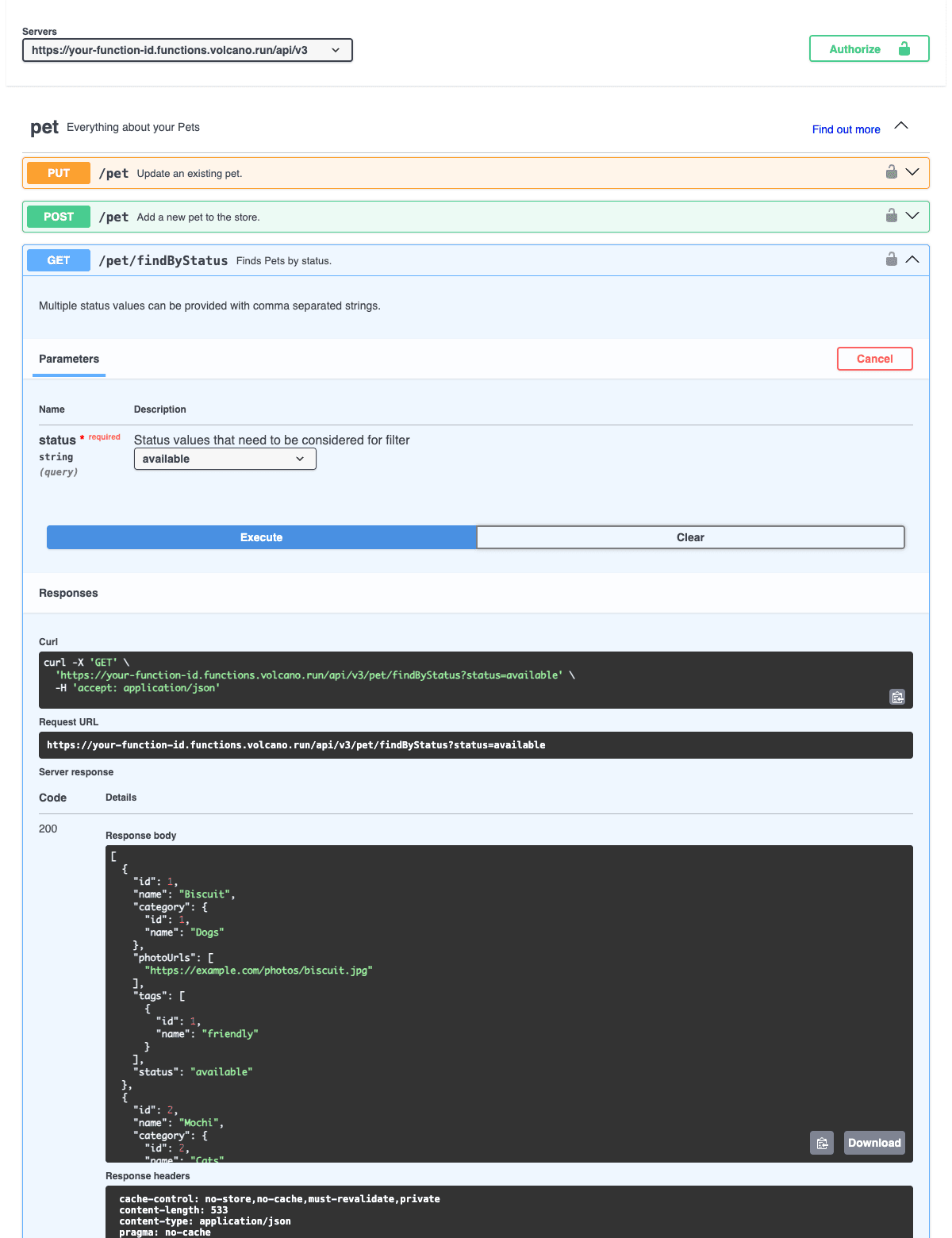
status(available) and send:200and the seeded pets. -
Get a token with the anon key from
volcano projects keys anon list. Send this to/auth/signuponce to create the account (passwords need 15 characters by default), then to/auth/signin:POST https://api.volcano.dev/auth/signin Authorization: Bearer <anon key> Content-Type: application/json {"email": "you@example.com", "password": "a-long-password-123"}Copy
access_token. It lasts an hour. -
Open Add a new pet to the store., set its auth to Bearer Token with that token and send the generated body:
200and the new pet with the id the database gave it. With auth set to None, or a token from an anonymous session:401.
Why it's built this way
An OpenAPI spec pins down paths and shapes but says nothing about who may change what. When this recipe was built, petstore3.swagger.io accepted POST /pet and DELETE /pet/{petId} with no credentials: fine for a sandbox, wrong for anything with users. Spell ownership out in the prompt and put it in the database, where it holds however the function code changes. The agents got the shapes right unaided; the two-user and anonymous-session checks proved the rules.
Where the API deviates from the spec:
- Auth: a registered user's Volcano access token as a bearer token on writes and nothing on reads, in place of the spec's OAuth 2
petstore_authandapi_keyheader. - Extra statuses:
401,403, and404onPOSTandDELETE /pet/{petId}.DELETEreturns an empty body. - JSON only.
POST /petignores anyidin the body. - No
uploadImage,storeoruser.userwould duplicate Volcano auth.
Other notes:
- Volcano's database API needs a signed-in session even for a public read, so reads use the direct connection with
application_name=volcano_user_access. The Codex run signed the function in as an anonymous user instead, which turns anonymous sign-ins on for the whole project. Its write policies refuse anonymous sessions, so that holds too. - An Express app on Fly or Render with Postgres, or a Cloudflare Worker with D1, works too, with ownership and users in your code.
- The first request after a deploy or an idle spell took 7 to 13 seconds, warm requests about 0.55 seconds.
Notes app with per-user data
A Next.js notes app on Volcano where each person only sees their own notes, enforced in the database with row-level security.
Remote MCP server with Postgres tools
Put an MCP server on a public HTTPS URL as a Volcano function, with bookmark tools in Postgres behind a bearer token, and call it from Insomnia or Claude Code.